


What Is BGA Rework Station
A BGA rework station is a specialized system used to replace or remove ball grid array (BGA) devices from printed circuit boards (PCBs). Technicians modify printed circuit boards (PCBs) with surface-mounted devices and ball grid array (BGA) packaging. We call this workspace system a BGA rework station. It's also referred to as a surface mount technology (SMT) or surface mount device (SMD) rework machine. A BGA station's features determine the size of the circuit board and the volumes or types of jobs it can complete, many stations may use low-volume or short-run productions for operation.
Advantages of BGA Rework Station
Volume
A BGA rework station can serve various sizes of PCBs. The machinery allows original equipment manufacturers and other companies to handle a high volume of rework jobs. Completing more rework services will enable you to serve more customers, increase revenue and accomplish your business-related goals.
Efficiency
The BGA rework stations include highly specialized tools such as component pickup tubes, solder balls and nozzles. Proper training to use the tools and machinery ensures technicians have the skills and knowledge to correctly utilize these components during rework tasks. The tools allow technicians to increase their speed and complete work on a fast timeline.
Accuracy
A technician can use the tools in a BGA rework station to complete skilled and detail-oriented tasks. The tools allow for safely and accurately completing many delicate processes, like reworking a ball grid array. With attention to detail and precision, technicians can complete reworking tasks without damaging the device.
Cost
The investment of a BGA rework station can offer a cost-effective solution compared to assembling or purchasing a new one. Reworking the machinery can produce a significantly longer PCB life span.
-

This professional-grade rework station is a comprehensive solution for precision soldering and
Add to Inquiry -
Our BGA Rework Station is a state-of-the-art smd soldering station engineered for accuracy,
Add to Inquiry -
Ball Grid Array Rework Station
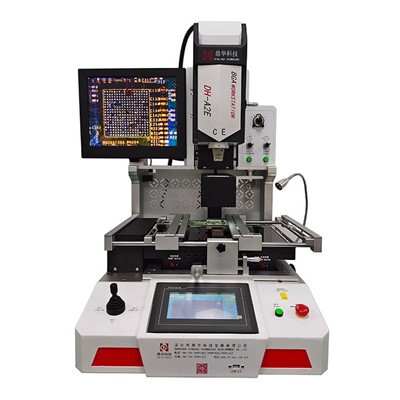
The DH-A2E represents a leap forward in rework technology, combining industrial automation with
Add to Inquiry -
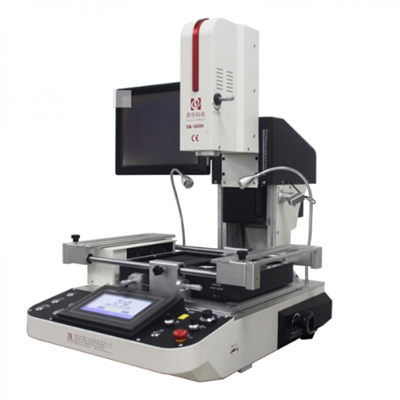
The DH-G600 is a professional smd bga rework station designed for precision repair of modern
Add to Inquiry -
The DH-5880 is a next-generation SMT rework station machine that combines intelligent automation
Add to Inquiry -
Dinghua 5880 BGA Rework Station – Professional Solution for Complex Board Repair
Add to Inquiry -
The Dinghua DH-5880 is a professional BGA rework machine designed for high-precision electronics
Add to Inquiry -
Revolutionize your rework process with our next-generation Infrared Soldering Station. Engineered
Add to Inquiry -
Bga Chip Soldering Desoldering Station
Our infrared BGA reballing station features a dual-CCD optical alignment system for ±0.01mm
Add to Inquiry -
Professional BGA Chip Desoldering and Soldering Machine | Advanced Mobile Repairing Tools |
Add to Inquiry -
Manual BGA Rework Systems DH-5830 are precision tools that allow users to remove, replace and
Add to Inquiry -
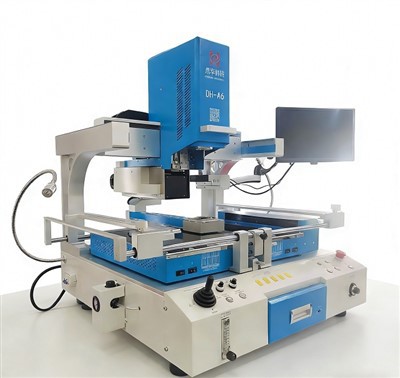
The DH-A6 is a fully automated, vision-guided BGA rework station machine designed for flawless
Add to Inquiry



Why Choose Us
Professional team
Our professional team collaborates and communicates effectively with each other, and is dedicated to delivering high quality results. We are capable of handling complex challenges and projects that require our specialized expertise and experience.
High quality
Our products are manufactured or executed to a very high standard, using the finest materials and manufacturing processes.
Advanced equipment
A machine, tool or instrument designed with advanced technology and functionality to perform highly specific tasks with greater precision, efficiency and reliability.
Competitive price
We offering a higher-quality product or service at an equivalent price. As a result we have a growing and loyal customer base.
Customized services
We understand that each customer has unique manufacturing needs. That’s why we offer customization options to cater to your specific requirements.
24H online service
We try and respond to all concerns within 24 hours and our teams are always at your disposal in case of any emergencies.
A rework is the finished result of a printed circuit board (PCB) that has been desoldered and resoldered. The processes and techniques employed to make all this happen are known as "reworking." Whereas new PCBs are mass produced, a faulty board must be repaired individually. Technicians who are skilled in board repair will often employ manual techniques, some of which involve the use of heated air guns. In cases where the ball grid array (BGA) needs to be repaired, the board will usually need to be heated to remove faulty parts and replace them with new ones. These steps are performed in a BGA rework station, which is a device designed and equipped for heating printed circuit boards to remove and replace malfunctioning parts. When a PCB is submitted to a rework station, the process will typically cover several BGA components, each of which must be corrected individually. Shielding equipment is often necessary to isolate the BGA and protect the surrounding areas on a board, otherwise, the PCB could end up damaged. The parts of the board that are not subject to any work need to be blocked from heat exposure. To prevent the possibility of board contractions, thermal stress is kept to a minimum. There are two basic kinds of rework stations for BGAs — hot air and infrared ray (IR). What sets these apart from one another is the way they heat a PCB. As their name suggests, hot air rework stations heat PCBs with hot air. Nozzles of varying diameter direct hot air on the areas of a circuit board that need repairs. Infrared ray stations use infrared heat lights or precision beams to heat PCBs. IR rework machines in the low- to mid-price range often use ceramic heaters and use louvers to isolate the areas of focus on a printed circuit board. The best IR rework stations are those in the upper price range that use focus beams, as these do a better job isolating the BGA without causing heat damage to surrounding areas. The beam can be focused on different areas with varying scope and intensity. If you need the beam to be larger on one spot and smaller on another, it can easily be done with a focus beam IR rework station.
Temperature Control of BGA Rework Station Is Very Important
The rework stations with the most user-friendly designs are those that come equipped with precision heaters at the top and bottom. With this design, you can keep the temperature consistent along both ends of the PCB. Hot air rework stations will typically employ focused heated air on the top and an unfocused board heater for the lower portion of the heating area. The flow of air will heat over the BGA and under the board as well. The bottom part of the heating compartment will consist of either a plate heater or an infrared light heater. On certain models, the plate will be equipped with holes that allow for the passage of heated air. If the area that you intend to heat is small, you may need to place the area directly above one of the holes in the plate from which heat emits. It might even be necessary to mark the spot where the PCB has been placed. If the hole and the spot are not properly aligned, the solder could be warmed to the wrong temperature. Additionally, rework stations should be equipped with a software program for setting temperatures and adjusting the temperature for each of the heaters to the exact degrees necessary for the project at hand. If properly designed, the rework station will calibrate the software temperature setting and the temperature of the heat that comes forth from the nozzle. The main problem is that the underside air is unfocused, which makes it difficult to guarantee an even spread of heat between the top and bottom of a given board. Without any feature that will focus the air along the bottom of the PCB, you might need to manually adjust the temperature along the underside of the heating compartment. The underside heaters on IR rework station models are designed with no bottom-side focus for the heated air. Some IR rework stations use a heat light equipped with a black diffuser that makes it easier to heat the circuit board evenly from one end to the other. Due to the inability for the software to calibrate with the heat on the infrared under-heater, there can be a temperature variance as wide as 100° C in certain units. On certain models, the software will not even allow you to set the heat in degrees. Instead, you are only allowed to set the heat in percentages, which can make settings even more difficult to set properly. You may need to place thermocouples on the printed circuit board and check the temperatures frequently. As you first get the process down, some of the chips are liable to wind up fried.
Key Features to Consider When Buying a BGA Rework Station
Hot air BGAs apply air with a pump. Consequently, hot air rework stations typically produce some degree of noise. Newer models are usually equipped with quieter pumps, though the sound issue is still a factor that you must accept if you use this type of rework station. IR stations usually produce no noise at all. If you need to limit the amount of noise that comes from your rework machine, an IR station would be the better option. Noise can be an issue in certain settings, especially if there are already several loud machines going at once. Hot air rework stations are equipped with nozzles that make it easier for users to focus the flow of air on different areas of a printed circuit board. When the process is conducted by a skilled set of hands, the task can often be completed sooner with a hot air BGA because such units make it easy to isolate the more delicate details that can be hard to heat. With a focus beam IR, you do not need to buy heat nozzles of different sizes, since each beam can refocus at your command. However, it will often take longer to bring more delicate details to the desired temperature. Sometimes the IR beam cannot heat the lighter details on a ball grid array. A particular problem area with IR beams are the silver spots on a BGA, which often need black tape to bring them to the necessary temperature. Additionally, your success rate with a rework machine will all depend on whether the unit is sufficient for the volume of reworks you hope to achieve in a given day. The best BGA rework station for high volume work will generally be of the heated air variety. A hot air station makes it easier to heat the solder and complete the job sooner. Hot air machines have more parts and accessories since you need different sized nozzles. This can make them more complicated to repair and maintain. IR BGAs consist of fewer complex parts, which allows for less complicated maintenance and repairs. On the downside, these units run the gamut in terms of quality, as some of the low-priced models are typically equipped with low-grade parts that offer subpar performance. When it comes time to perform a more complex set of tasks with a lower grade IR rework station, extra tools will often be required. You should also consider the frequency at which maintenance is liable to be necessary for the respective unit. If a rework station consists of numerous complicated parts, the likelihood of a breakdown could be a real and costly threat. If the rework machine consists of a minimum of parts yet offers excellent results, you have probably found the best rework station. Another important feature on a reworking station is an automatic cooling fan. With this feature, the printed circuit board and each of the heaters in the machine will all be cooled when necessary. As you work on one PCB after another, the unit will automatically cool as needed between each board. A cooling fan is essential for project efficiency on most reworking stations, which tend to cool slowly between applications. BGA machines that use drilled metal plates can take especially long to cool. The size and sensitivity of your boards can also affect which type of rework station is best for your operations. Some machines can hold boards up to 36 inches. The space within the heater should accommodate the circuit board well enough to bring the entire PCB up to 150° C. This should help offset any possible warping effects. The age of your boards may also affect which machine is best. Over the past two decades, lead-free soldering has become the new standard in manufacturing. Consequently, reworking requires higher temperatures on newer printed circuit boards. On older PCBs, less heat was required for reworking because tin-lead solder melts at lower temperatures. If you work primarily with newer PCBs, you may need a more powerful station that can achieve higher temperatures.

BGA rework stations have several different applications in the world of PCB repair and alteration. Here are a few of the most common applications. A range of mistakes can occur during the rework process. For example, the PCB may have incorrect BGA orientation or a poorly developed BGA rework thermal profile. In this case, the PCB will likely need to undergo further rework to address the faulty assembly. PCBs can have various defective parts that may require rework. While pads could get damaged during BGA removal, any number of components could be heat-damaged, or there could be too much solder joint voiding. Often, technicians complete reworks to upgrade various components. Professionals can replace a PCB's outdated or low-quality parts for improved quality, performance and longevity. Hot air BGA rework stations use hot air to heat up the PCB components during the project. Several different nozzles guide and circulate hot air to ensure even heat distribution. Technicians can move these nozzles to direct air, allowing work on small, delicate components to get accomplished quickly. The use of air pumps means there will be some level of noise when using a hot air BGA rework station, though many models can run very quietly. Because hot air is an older technology, more technicians have training in using hot air BGA rework stations as opposed to IR BGA rework stations.
Operation Principle of BGA Rework Station
Professionals who have done BGA rework station work know that "warming up" is the prerequisite for successful rework. PCB processing at high temperature (315-426°C) for a long time will bring many potential problems. Thermal damage, such as pad and lead warping, substrate delamination, white spots or blistering, and discoloration. The "invisible" damage to PCB caused by high temperature is even more serious than the problems listed above. The reason for the huge thermal stress is that when PCB components at room temperature suddenly contact a soldering iron with a heat source of about 370°C, a desoldering tool or a hot air head to stop local heating, there will be a temperature difference of about 349°C on the circuit board and its components, resulting in "Popcorn" phenomenon. Therefore, regardless of whether the PCB assembly plant uses wave soldering, infrared vapor phase or convection reflow soldering, each method generally requires preheating or heat preservation treatment, and the temperature is generally 140-160°C. Before the implementation of reflow soldering, a simple short-term preheating of the PCB can deal with many problems during rework. This has been successful for several years in the reflow soldering process. Therefore, the benefits of stopping preheating in the prevalence of PCB components are manifold.
BGA rework stations — also called SMT and SMD rework stations — play a critical role in printed circuit board repair and modification. As their names imply, rework stations are spaces where technicians can alter surface-mounted devices and circuit boards with ball grid array (BGA) packaging. This is useful for several refinishing and repairing applications, including removing defective components, replacing missing components, reversing components that were installed incorrectly, and more.A BGA rework station allows technicians to do several different things, including refinishing, rework and repair. These rework stations empower technicians to remove defective parts, reinstall incorrectly placed parts, replace any missing parts and remove parts that are no longer working. BGA rework stations can be placed on a flat surface, or technicians can use BGA rework stations that come mounted on a cabinet with wheels. BGA rework is a delicate process that requires skill and attention to detail. It is all too easy to damage the entire PCB when trying to rework a ball grid array. BGA rework stations offer the tools to achieve the necessary precision to complete the rework job accurately and safely, without damaging the entire device. The highly specialized tools — such as nozzles, solder balls and component pickup tubes — that come with a BGA rework station ensure trained technicians can efficiently tackle the rework job at hand.

Our Factory
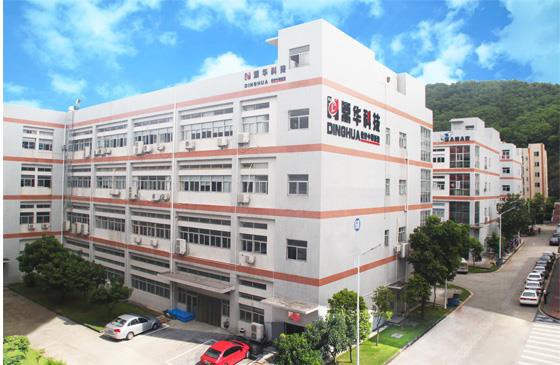
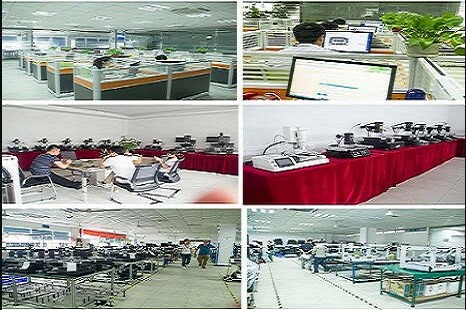
Shenzhen Dinghua Technology Development Co., Ltd. is a national high-tech enterprise integrating R&D, production, sales and service! Which is a professional BGA rework station, automatic soldering machine, Xray inspection machine, U-shaped line transformation and non-standard automation system solutions and industrial equipment providers! The company is "based on research and development, quality is the core, service is the guarantee", and is committed to creating "professional equipment, professional quality, and professional service"!



FAQ
