


Hot Air Smd Bga Rework Station
Easy to operate. Suitable for chips and motherboard of different sizes. High successful rate of repairing.
Description
DH-A2 Hot air smd bga rework station
1.Application Of DH-A2 BGA Rework Station
1.BGA component repair: The DH-A2 BGA Rework Station is specially designed to repair damaged or faulty BGA components on
circuit boards. It can remove and replace BGA chips quickly and accurately, ensuring that the circuit board is restored to its original
working condition.
2. BGA reballing: Reballing is the process of replacing the solder balls on a BGA chip. DH-A2 BGA Rework Station can effectively
remove the old solder balls and apply new ones, ensuring that the BGA chip is firmly attached to the circuit board and that there are
no connectivity issues.
3. Microsoldering: The DH-A2 BGA Rework Station is also suitable for microsoldering small components on circuit boards. It can handle
tiny components such as resistors, capacitors, and diodes with ease, making it a versatile tool for intricate rework applications.
4. Prototype development: The DH-A2 BGA Rework Station is an essential tool for prototype development in the electronics industry.
It can remove and replace components on prototype boards quickly and accurately, allowing engineers to test different designs and
configurations without the need for expensive and time-consuming PCB manufacturing.
In conclusion, the DH-A2 BGA Rework Station is an essential tool for repairing and reworking BGA components on circuit boards.
With its accuracy, speed, and versatility, it is widely used in various industries, making it an indispensable tool for electronic engineers
and technicians.
2.Product Features of DH-A2 Hot air smd bga rework station

• Desoldering, mounting and soldering automatically.
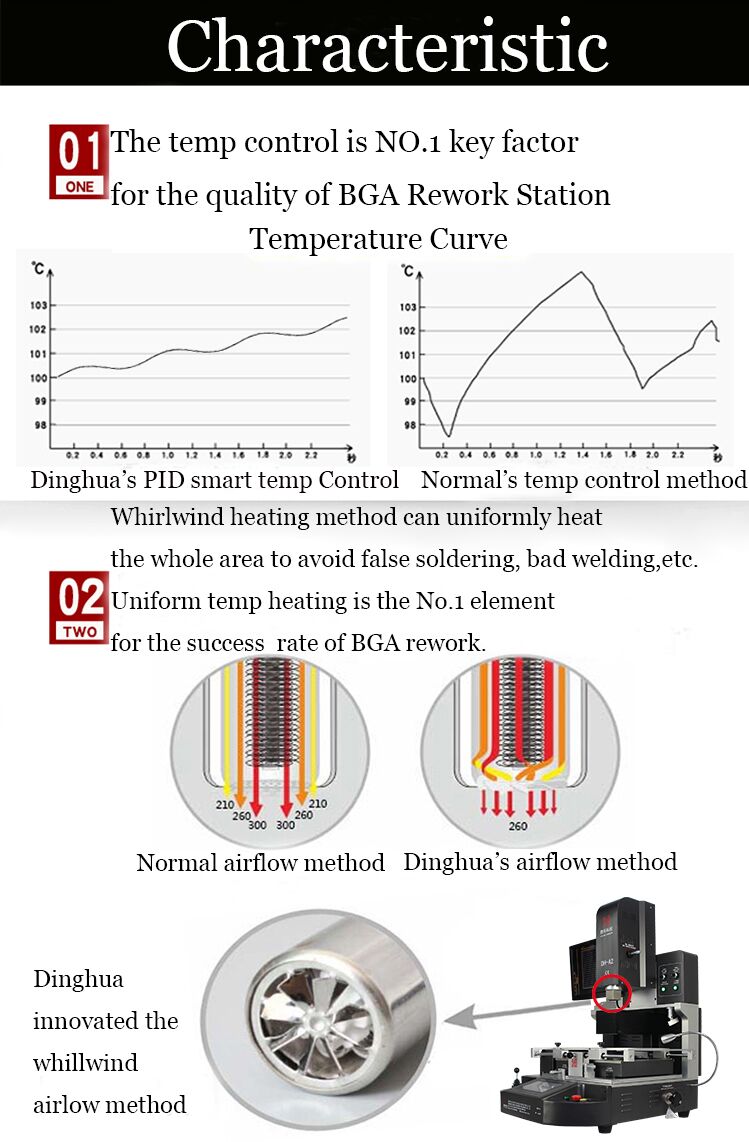
• Characteristic of high volume (250 l/min), low pressure (0.22kg/ cm2), low temp (220°C) rework completely guarantees
BGA chips electricity and excellent soldering quality.
•Utilization of silent and low-pressure type air blower permits the regulation of silent ventilator, the airflow can be
regulated to 250 l/Min the maximum.
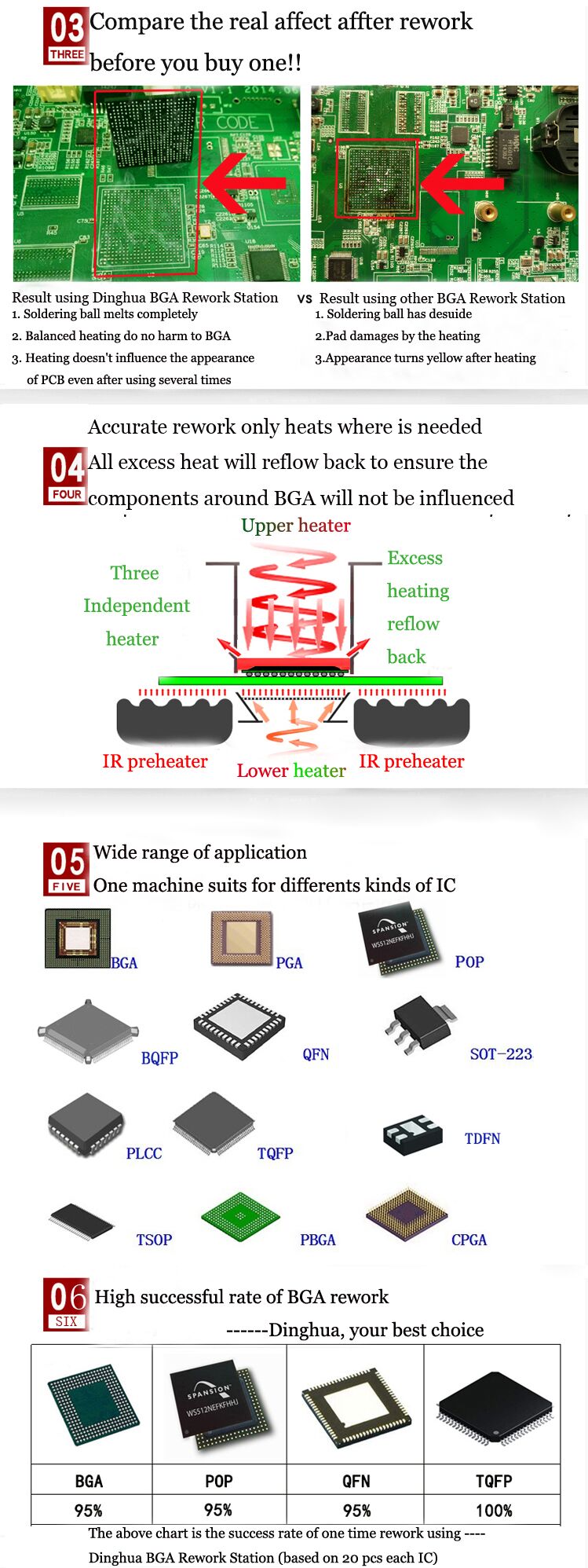
•Hot air multi-hole round center support is especially useful for big-size PCB and BGA located in the center of PCB. Avoid
cold soldering and IC-drop situation.
•The temperature profile of bottom hot air heater can reach as high as 300°C, critical for big size motherboard. Meanwhile,
the upper heater could be set as synchronized or independent work.
3.Specification of Hot air smd bga rework station
| Power | 5300W |
| Top heater | Hot air 1200W |
| Bollom heater | Hot air 1200W, Infrared 2700W |
| Power supply | AC220V± 10% 50/60Hz |
| Dimension | L530*W670*H790 mm |
| Posilioning | V-groove PCB support, and with external universal fixture |
| Temperature control | K type thermocouple. closed loop control. independent heating |
| Temperalure accuracy | ±2℃ |
| PCB size | Max 450*490 mm, Min 22*22 mm |
| Workbench fine-tuning | ±15mm forward/backward, ±15mm righ/left |
| BGAchip | 80*80-1*1mm |
| Minimum chip spacing | 0.15mm |
| Temp Sensor | 1(opional) |
| Net weight | 70kg |
4.Details of DH-A2 Hot air smd bga rework station

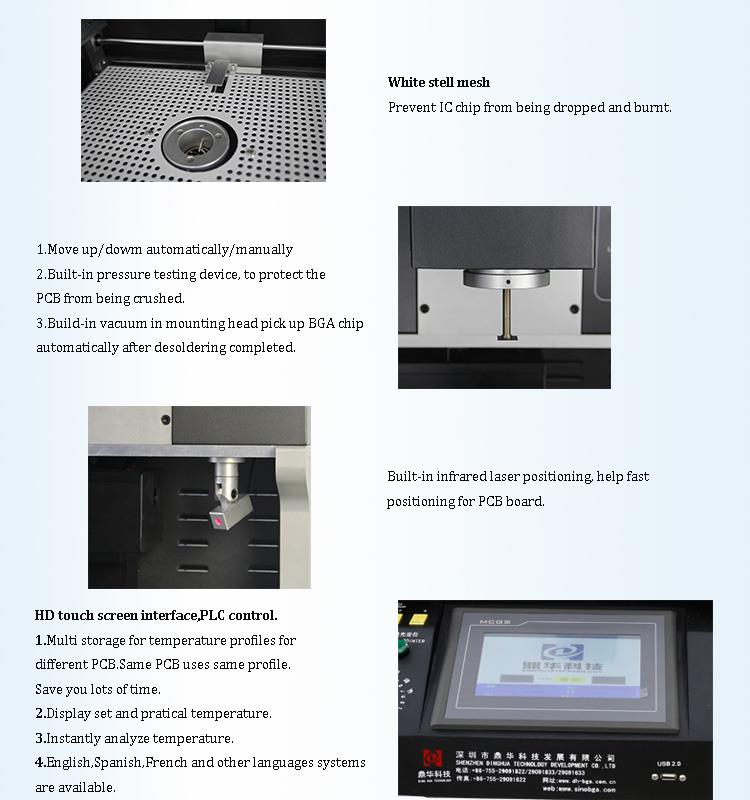
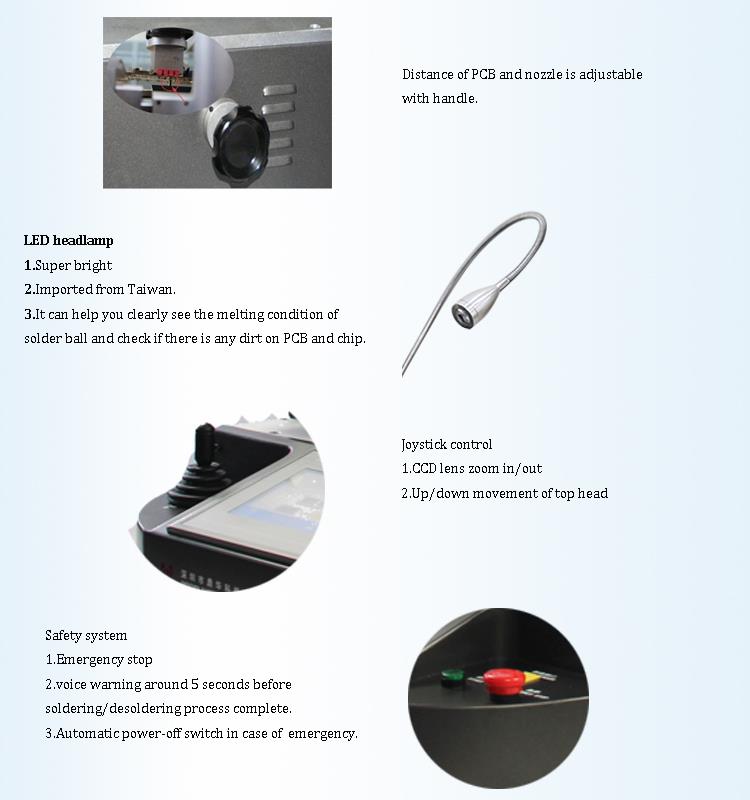
5.Why Choose Our DH-A2 BGA Rework Station?
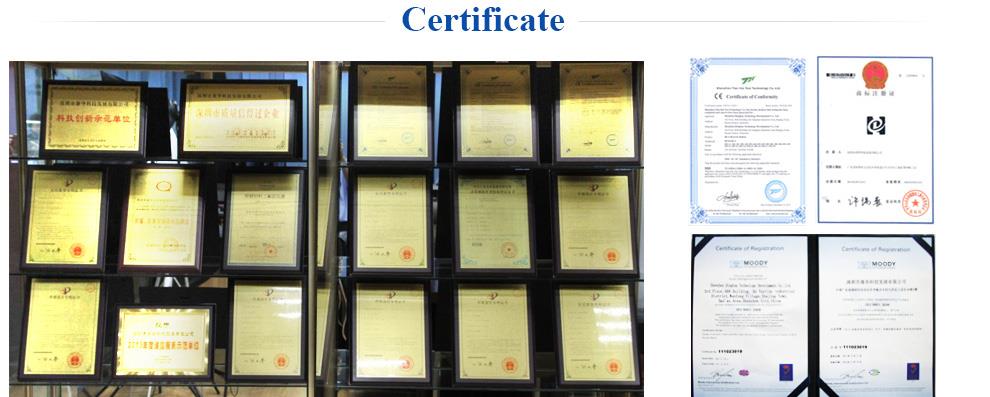
6.Certificate of DH-A2 BGA Rework Station
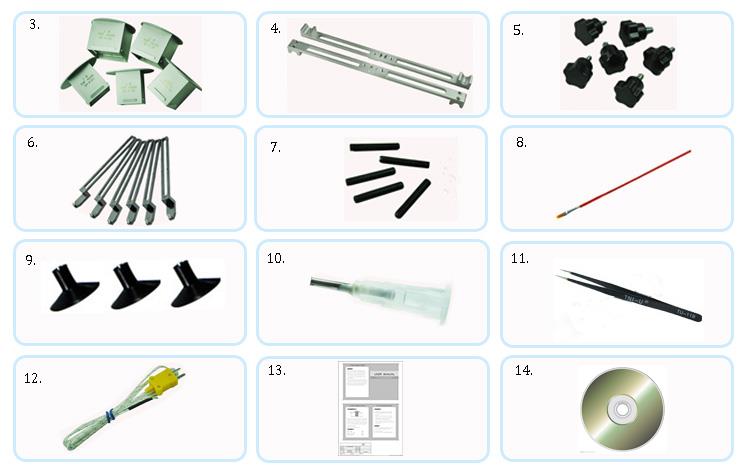
7.Packing & Shipment of DH-A2 BGA Rework Station

8.Related knowledge of DH-A2 Hot air smd bga rework station
A) a few questions that we may notice:
Select the appropriate air nozzle, point the air nozzle at the BGA chip to be removed, insert the end of the temperature
measurement cable into the temperature measurement interface of the BGA rework station, and insert the temperature
measurement head at the bottom of the BGA chip. Set the temperature curve according to the following table and save it
for next use.
2. Start the BGA rework station. After a period of time, use the tweezers to touch the chip without interruption. Here you
need to be careful not to touch it too hard. When the tweezers touch the chip and can move slightly, then the melting point
of the chip is reached. At this time you can measure the temperature, then modify the temperature curve and save it.
3. When we know the melting point of the chip, then this temperature can be set as the maximum temperature for soldering,
and the time is generally about 20 seconds for the equipment. This is the method to detect the temperature of your chip whether
it is leaded or lead-free. Generally, the surface temperature of BGA is set to the highest temperature when the actual temperature
of lead reaches 183 degrees. When the actual temperature of lead-free reaches 217 degrees, BGA The surface temperature is set
to the maximum temperature.
B) Preheating to constant temperature:
1. Preheating
The main role of the temperature pre-heating and heating section is to remove moisture from the PCB board, prevent blistering,
and pre-heat the entire PCB to prevent thermal damage. Therefore, it should be noted in the preheating stage that the temperature
should be set between 60 ° C and 100 ° C, and the time can be controlled at about 45s to achieve the preheating effect. Of course, in
this step, you can extend or shorten the warm-up time according to the actual situation, because the increase in temperature depends
on your environment.
2. Constant temperature
At the end of the second period of constant temperature operation, the temperature of the BGA should be kept between (lead-free:
150 ~ 190 ° C, with lead: 150-183 ° C). If it is too high, it means that the temperature of the heating section we set is too high You can
set the temperature of this section lower or shorten the time. If it is too low, you can increase the temperature of the preheating section
and the heating section or increase the time. (Lead-free 150-190 ° C, time 60-90s; with lead 150-183 ° C, time 60-120s).
In this temperature section, we generally set the temperature slightly lower than the temperature in the heating section. The purpose is
to equalize the temperature inside the solder ball, so that the overall temperature of the BGA is averaged, and those temperatures are
slowly lowered. And this section can activate the flux, remove the oxide and surface film on the metal surface to be soldered, and the
volatiles of the flux itself, enhance the wetting effect and reduce the effect of temperature difference. The temperature of the actual
test solder ball in the constant temperature section is required to be controlled (lead-free: 170 ~ 185 ℃, leaded 145 ~ 160 ℃), and the time can be 30-50s.


