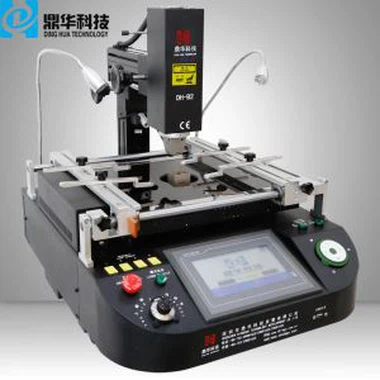
Optical Cell Phone BGA Rework Station
A BGA Rework Station is a specialized tool used in the repair and rework of electronic circuit boards.BGA stands for ball grid array, which is a type of surface mount technology that uses tiny solder balls to connect the electronic components to the board.
Description
1. Product Introduction
The DH-A2 BGA rework station is tool-free, gas-free, and provides instant and precise control. It is clean, modular, upgradeable, and guarantees 100% yield in BGA rework without complications. The station offers extremely high levels of profiling and process control, essential for effective rework of even the most advanced packages, including SMDs, BGAs, CSPs, QFNs, and Flipchips. It is also ready for 0201 and lead-free applications.
2. Product Specifications

3. Product Applications
BGA rework involves accessing hidden interconnects in a high-density environment, which requires a station capable of reaching these hidden joints without damaging neighboring components. The DH-A2 is a station that meets these demands-safe, gentle, adaptable, and, above all, easy to operate. Technicians can instantly achieve excellent process control for BGA/SMT rework, without the complexities and frustrations typically associated with 'high-end' rework stations.

4. Product details

5. Product Qualifications


6. Our Services
- Free training on how to use our machines.
- 1-year warranty and lifetime technical support.
- Inquiries or emails will be responded to within 24 hours.
- Best price directly from the original Dinghua factory, with no intermediary fees.
- Brand new machines shipped directly from Dinghua factory workshops.
- Special agent pricing available. We welcome agents!
7. FAQ
What temperature does solder reflow at?
With the soak zone at 150°C and the reflow zone at 245°C (a typical value for lead-free reflow soldering), the temperature rise from the soak zone to the reflow zone is 95°C. Due to thermal inertia, such a rapid temperature rise may cause temperature differences across the PCB.
Thermal Profiling
Thermal profiling is the process of measuring several points on a circuit board to track its temperature changes during the soldering process. In the electronics manufacturing industry, SPC (Statistical Process Control) is used to determine whether the process is in control, based on reflow parameters defined by soldering technologies and component requirements.