


BGA Machine For Laptop
Cost-effective model with monitor and splited camera Auto suction or replacing for a chip PID for temperature compensation Chip availble from 1*1 to 80*80mm
Description
BGA machine for laptop mobile phone and hashboard
Designed in 2021,upgraded from DH-G620, more automatic for BGA,POP,QFN and
other chips desoldering, mounting and soldering, beautiful look and pratical function,
such as, HD monitor, splited camera for dots of chip&PCB and laser point for simple
locating, which are very satified with reworking on macbook, desktop, car PCBA, hash
board and game console machine repairing,etc.
Ⅰ. Parameter of BGA rework machine for bga rework automatic machine
| Power supply | 110~240V 50/60Hz |
| Rated power | 5500W bga rework station machine |
| Heating mode | Independent for 3-heating-zone |
| Chip pick-up | Vacuum activated by pressure |
| Chip dots imaging | imaged on monitor by camera taking |
| Laser point | pointed at center of chip bga laser rework machine |
| USB port | System upgraded, temperature profile downloaded |
| Zoom in/out | Max 200x with automatic focous |
| PCB size | 370*410mm best bga rework machine |
| Chip size | 1*1~80*80mm |
| PCB position |
V-groove, Moveable platform at X, Y with universal fixtures |
| Monitor screen |
15 inches |
| Touchscreen | 7 inches bga rework system |
| Thermocouple | 1 pcs (optional) |
| LED bulb | 10W with flexible stem |
| Upper air-flow | adjustable |
| Cooling system | automatic |
| Dimension | 700*600*880mm |
| Gross weight | 65kg bga bga repair machine for laptop motherboard |
Ⅱ. A part of chips which often are reworked as below:
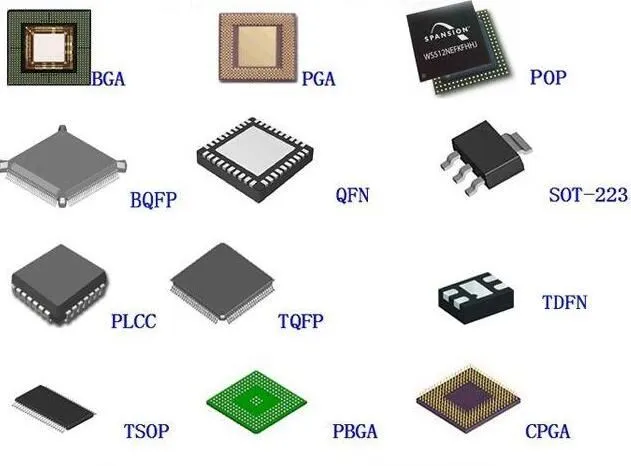
nglish
In fact, we can not rework these chips as above, but also the flip chip components,which are
rarely used in PCB assembly, but they are becoming increasingly important as the need for
miniaturization of electronic components grows. Flip chips are bare chips that are mounted
directly on the circuit carrier without any further connecting wires, with the active side facing
down. This means they are exceptionally small in size. This technique is often the only suitable
assembly possibility for very complex circuits with thousands of contacts. Typically, flip chips
are assembled via conductive bonding or pressure bonding (thermocompression bonding),
other options include soldering, which is the way we do.
Ⅲ. Fundamental of desoldeirng and soldering of bga rework equipment

There are 2 hot-air for soldering or desoldering, and 1 large IR preheating area for PCB being preheated,
which can make PCB protected during heating or heating finished. bga station
Ⅳ. Machine's structure and function of bga rework station machine price
| Upper head | Auto up and down with upper hot-air heater of bga machine |
| Monitor screen | chip and motherboard imaging on reballing machine |
| Optical CCD | split-vision for chip and motherboard |
| IR preheating | PCB preheating bga machine price |
| Cooling fan | Auto start after maschine stop working |
| Left IR switch | IR switch of bga reballing machine |
| Zoom in/out | press down |
| Laser point | press down |
| Light switch | press down |
| Angel rotating | Rotating |
| Light | Lighting |
| Lower/upper nozzle | soldering or desoldering |
| Micrometers | PCB moved +/- 15mm at X or Y axis |
| Right IR switch | IR switch |
| Upper HR adjusting | Hot-air-flow adjusting bga rework machine |
| CCD light adjusting | Light source adjusting |
| Emergency knob | Press down |
| Start | Press down |
| Thermocouple port | External temperature testing, 1 pcs mobile ic reballing machine |
| Human-machine operation interface | Touchscreen for time and temperature setting |
Ⅴ. Demo video of best bga rework machine
Ⅵ. After-sales service of ic reballing machine
Warranty: 12 months or more (depends on customer's requirement)
Service way: online support or video-call, dispatching engineers to on-site/filed is available as well.
Service cost: free parts in warraty period, free service but a little price-cost after warranty. for auto-
matic bga reballing machine.
Ⅶ.Shipping term of chip reballing machine
Min order: 1 set, we suggest using express way for less quantity.
If massive quantity, sea or rail wai shipping is availble. for chip reballing machine
EXW, FOB or DAP and DDP etc. are OK.
Ⅷ. Relevant knowledge of BGA rework machine bga placement machine
Rework is defined as an operation which returns a printed wiring assembly (PWA)/part to its original
configuration. Rework should not be considered as repair. Some of the important requirements of
rework are as follows:
§ There is no electrical or mechanical damage imparted to the PWA.
§ Proper equipment is available to accomplish the rework.
§ Rework should be performed only after proper documentation of discrepancies.
§ The rework procedures, whether in-house or at the vendor/contract manufacturer, should be approved.
§ The PWA should be cleaned prior to the rework using approved procedures. Special cleaning procedures
should be adopted if conformal coating exists on the PWA.
§ The use of a solder wicking braid is permissible during rework.
1. Coplanarity
The coplanarity of a part/PWA should meet the above requirements, metallic tweezers should not be used
to rework leaded parts, molded tools should be employed to handle the PWA during rework, Electrostatic
Discharge (ESD) safe tools should be used, cleaning after coplanarity rework, etc.
1.1Solder Paste and Part Alignment Rework (Pre-reflow)
Solder paste and parts that do not meet the alignment requirements may be reworked as follows: manually
realign with the aid of an approved hand tool, the solder paste not to be disturbed and this process should
not exhibit smearing or bridging after the part movement. If the solder becomes smeared the part and solder
paste should be carefully removed and all visible traces of solder paste should also be removed from the affe-
cted area on the PWB. If the PWB is populated with additional parts, new solder paste should be deposited on
the footprint with a solder paste syringe dispenser, and the part remounted. If the PWB is unpopulated it shou-
ld be completely cleaned of solder paste, and the cleaned PWB should be inspected for conformance of manuf-
acturing. The parts may be reused after the parts leads are cleaned using approved solvent, etc.
1.2Part Replacement and Realignment (Post-reflow)
Hot air or hot gas rework stations are permissible provided it can be demonstrated the hot air or gas does not
reflow the solder of the adjacent solder connections. Wicking of solder with wicking braid and a hand soldering
tool is permissible for most parts. The exceptions are leadless chip carriers, ceramic capacitors, and resistors. The
reworked area should be cleaned thoroughly prior to the deposition of fresh solder paste. Hand soldering of par-
ts is permissible provided all necessary precautions are observed to prevent part damage.
With the continuing evolution toward smaller components, higher board densities and more diverse mixes, proc-
ess equipment has been extended beyond the limits of its capabilities. In an industry where lead pitches and chip
sizes are beyond the limits of the naked eye, components are being mounted at ever-higher speeds. This means
rework is a fact of life and will remain so into the foreseeable future. Repairing and reworking a PWB can be acco-
mplished at any point during the assembly. Today's rework stations have the capability to remove components
with nozzles that direct heat at prescribed temperatures to the component interconnects. As a result, the solder
melts without surrounding devices being affected. The component is then lifted from the board using a vacuum
pickup incorporated in the nozzle. More sophisticated machines also incorporate vision alignment to ensure pre-
cision in mounting the replacement component. Reworking components on PWB is not restricted to leaded devi-
ces or even FR-4 substrates. Array components, such as ball grid arrays and flip-chips, can be removed and repla-
ced. Flip-chips can be reworked because testing of the components usually occurs prior to dispensing and curing
of the underfill. For components where the underfill has been applied, the process is more complicated, as the e-
poxy is more difficult to remove from the board.
Rework systems differ in design and capability. Certain features, however, are particularly important to successfully
replace defective components. As with assembly, the bottom line is cost and throughput, as well as passing inspe-
ction test. Rework should be independent of the individual operation. A flat platform for achieving coplanarity and
an X-Y alignment system that ensures precision and repeatability in positioning are paramount. Substrate mounting
should be secured in a fixture that permits the board to expand during heating, and the platform should incorporate
adjustable supports for the underside of the board to prevent sagging because of heat and component weight .


