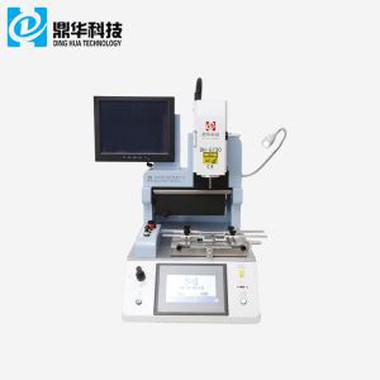
IR Optical BGA Rework Station
1. With large IR preheating area
2. Adjustable hot-air flow for various chips
Description
1. Product Introduction
The flexible rework powerhouse for challenging tasks
- Powerful hot air heating in the top emitter: 1,200 W
- Powerful hot air heating in the lower emitter: 1,200 W
- Strong infrared preheating in the bottom emitter: 2,700 W
- Four thermocouple channels for precise temperature measurement
- Dynamic IR heating technology for large PCBs (370 × 450 mm)
- High-precision (+/- 0.025 mm) Auto Pick & Place with motorized zoom AF camera
- Intuitive operation via 7" touchscreen with 800×480 resolution
- Built-in USB 2.0 port
- Motorized zoom reflow process camera for process monitoring
- Advanced automatic chip feeding system
2. Product Specifications
| Dimensions (W x D x H) in mm | 660 × 620 × 850 |
| Weight in kg | 70 |
| Antistatic Design (y/n) | Y |
| Power Rating in W | 5300 |
| Nominal voltage in V AC | 220 |
| Upper heating | Hot air 1200w |
| Lower heating | Hot air 1200w |
| Preheating area | Infrared 2700w, size 250 x330mm |
| PCB size in mm | from 20 x 20 to 370 x 410 (+x) |
| Component size in mm | from 1 x 1 to 80 x 80 |
| Operation | 7-inch built-in touch screen. 800*480 resolution |
| Test symbol | CE |
3. Product Applications
The Dinghua DH-A2E is an advanced hot air rework station designed for the assembly and rework of all types of SMD components.
This system is a best-seller for professional mobile device rework in high-density environments. Its high level of process modularity allows all rework steps to be completed within a single system. The DH-A2E is ideal for use in R&D, process development, prototyping, and production settings.
It supports applications ranging from 01005 components to large BGAs on small- to medium-sized PCBs, ensuring highly reproducible soldering results.
Highlights
- Industry-leading thermal management
- High-efficiency board heater
- Closed-loop force control
- Automated top heater calibration

4. Product details


5. Product Qualifications


6. Our Services
Dinghua is a recognized global leader in developing solutions for the assembly and repair of advanced electronic systems.
Today, Dinghua continues to offer innovative products, solutions, and training for the rework and repair of printed circuit assemblies.
Our unique capabilities and forward-thinking vision have delivered universal solutions for both through-hole and surface-mount assembly and rework challenges in high-end electronics.
Our strong commitment and proven track record have resulted in a comprehensive range of assembly and repair solutions tailored to meet your needs-whether you're working to ISO 9000 standards, industrial specifications, military requirements, or your own internal guidelines. Whatever the challenge, Dinghua is ready to set a new benchmark for you.
Dinghua - Over 10 years of industry leadership, delivering systems and solutions for soldering, rework, and electronic repair.
7. FAQ
Electronic devices and gadgets are becoming smaller and slimmer every day, thanks to continuous technological advancements in the electronics industry. The world's top electronics companies are competing to produce the most compact and efficient devices.
Two key technologies driving this trend are SMDs (Surface Mount Devices) and BGAs (Ball Grid Arrays)-compact electronic components that help reduce the size of devices.
Understanding BGA: What is Ball Grid Array and Why Use It?
BGA, or Ball Grid Array, is a type of packaging used in Surface Mount Technology (SMT), where electronic components are directly mounted onto the surface of printed circuit boards (PCBs). Unlike traditional components with leads or pins, a BGA package uses an array of metal alloy balls arranged in a grid-hence the name.
These solder balls are typically made of Tin/Lead (Sn/Pb 63/37) or Tin/Lead/Silver (Sn/Pb/Ag) alloys.
Advantages of BGA over SMDs:
Modern PCBs are densely packed with electronic components. As the number of components increases, so does the size of the circuit board. To minimize PCB size, SMD and BGA components are used because they are compact and require less space.
While both technologies help reduce board size, BGA components offer several distinct advantages-as long as they are soldered correctly to ensure a reliable connection.
Additional Benefits of BGA:
- Improved PCB design due to reduced trace density
- Robust and durable packaging
- Lower thermal resistance
- Better high-speed performance and connectivity