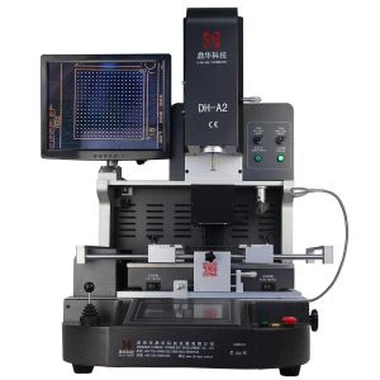
High Automatic IC QFN Reballing Machine For PCBA
The BGA/SMD rework station DH-A2E has automatic optical CCD with a chip feeder, automatically soldering and desoldering for a component on PCBA of computer, mobile phone, GPS tracker, Projector formater and the controlling mainboard of cars.
Description
-
Product instruction
An Optical CCD and a chip feeder:
-
The optical CCD is automatically running for imaging on a display screen
-
The chip feeder can run for a component replace on or pick up from

Display screen for imaging
-
15 inches, HD for a component with a solder dot 0.1*0.1mm imaged on
-
consists of RGR, one color for a component, one color for motherboard.

A large IR preheating zone for most of a mainboard
-
Glass-shield for IR, which makes human labor and component protected
-
Evenly temperature to a whole of a motherboard.

Adjustable buttons or knob
-
Top airflow button adjusted for a microchip soldering
-
Top/down light adjusted for an image cleared on a monitor screen.

A joystick for top head adjusted
-
when manual, the top head can be moved up or down by it
-
The first to set a PCBA position, it needs to be used.

An operation interface on a touchscreen
-
One key to start until soldering or desoldering finished
-
changing or saving is easy to set .

The parameters of the reballing machine:
| Power supply | 110~250V 50/60Hz |
| power | 5400W |
| An automatic optical CCD system | automatically go out and back with a chip feeder |
| Power supply | Meanwell, as known brand |
| Motors of cooling fans | Taida made in Taiwan |
| Touchscreen | MCGS, sensitive and HD |
| Components applicated | BGA, IC, QFN, POP etc. |
| Min space |
0.15mm |
FAQ of High automatic IC QFN reballing machine for PCBA of computer soldering and desoldering
Q: what is the voltage I can use for?
A: from 110V~250V, optional for different country usage.
Q: what can i do on a BGA reballing machine?
A: soldering, desoldering for a component, such as, BGA, QFN, IC and POP and so on.
Q: where is it manufactured?
A: Made in China-- cost-effective and high-quality
Q:What else can your factory make?
A: except BGA rework station, we also can manufacture automatic screw locking machine, soldering station etc.
The related knowledge of an automatic IC QFN reballing machine for PCBA of computer soldering and desoldering
The purpose of the welding course is to provide the operator with advanced notions on all modern welding techniques
using manual welders, hot air welders,IR welders, preheaters. The course is characterized by a theoretical part and a practice in which the student can immediately experiment with all the types of welding shown in the program.
The evolution of electronic components has become increasingly critical, presenting its increasingly miniaturized
appearance in the package and with a high pin count; this development guideline has led to the development of
increasingly complex (and expensive) reworking systems. A typical example is given by the BGA packages and the
respective µBGA and CSP versions that introduce problems at the inspection level of the welding joints, whose reliability
is rendered precarious by the possible formation of a void. The quality of manual welding depends on different variables, operator capacity, wire quality, goodness and efficiency of the welding station. Manual welding is also influenced by the evolution of the technological world that surrounds it and to which it must respond with always innovative solutions. In
manual welding operations, there is always a close cause-effect relationship that links the operator's ability and the performance of the welding or rework station. Even the best welding station can do nothing against an operator without skills. On the other hand, an operator with skills and education, with an excellent welding system, able to rework even the most desperate case, will never be able to balance those gaps that generated the process because the objective of the process is the first-pass yield and recovering during rework is a cost and not a plus. However, a high technological level
of the equipment used contributes to the positive outcome of the operations because it allows good control of most of
the variables involved. This is basically one of the motivations that have pushed towards stations with excellent
performances.
the other is the need to have efficient systems. The efficient thermal transfer allows repetitive welding, with a stable temperature level, without oscillations due to the slow recovery of the thermal power. In the rework operations, four
phases can be identified: the desoldering and removal of the component, the cleaning of the pads, the positioning
of the new component and its welding. In the case of complex components such as those belonging to the area array
family, serigraphy or dispensing of the solder paste is also required. One of the major problems encountered at the operational level is the placement of the mini-stencils used to deposit the paste on the pads of the reworked component.
This operation, if not carried out correctly, also compromises the subsequent re-melting and joint formation phase. Other practical difficulties occur more directly in the repair process and derive from the increase in the number of terminals and the reduction in their pace. Often the PCB also decreases in size, reducing more and more useful spaces to intervene with the risk of interfering with the surrounding components.