


Automated Soldering For LED Light
Automated Soldering for LED Light. Different design and different solutions.
Description
1.Models for Automated Soldering for LED Light
A. Single head, single station,(R axis)
B. Single head, double stations,(R axis)
C. Double heads, single station,(R axis)
D.Double heads, double stations,(R axis).
E. Other customized designs are available. Welcome to contact us.

2.Features for Automated Soldering for LED Light
Effective decline human effort and labor cost.
Use-friendly.
Stable performance and durable.

3. Application of Automated Soldering for LED Lights
Automated soldering is becoming increasingly popular in the manufacturing process of LED lights. This process involves the use of soldering machines programmed to perform precise soldering operations automatically. As a result, this technology provides numerous benefits for LED light production.
Firstly, automated soldering ensures consistency and accuracy in the soldering process. The machines operate at a consistent speed, temperature, and pressure, eliminating the risk of human error. This ensures that all connections are secure and that the final product is of high quality.
Secondly, automated soldering significantly reduces the production time for LED lights. The process is much faster than manual soldering, as the machines can solder multiple connections simultaneously. This enables manufacturers to produce LED lights at a faster rate, lowering production costs and improving efficiency.
Thirdly, automated soldering eliminates risks to workers. Manual soldering can expose workers to high temperatures and toxic fumes, making it hazardous. Automated soldering removes these risks, as machines handle all soldering tasks without requiring human intervention.
In conclusion, automated soldering offers numerous benefits in LED light production. It ensures consistent and accurate results, reduces production time and costs, and eliminates worker safety risks. As demand for LED lights continues to grow, automated soldering has become an indispensable tool for manufacturers aiming to remain competitive and produce high-quality products efficiently.
6.Certificate
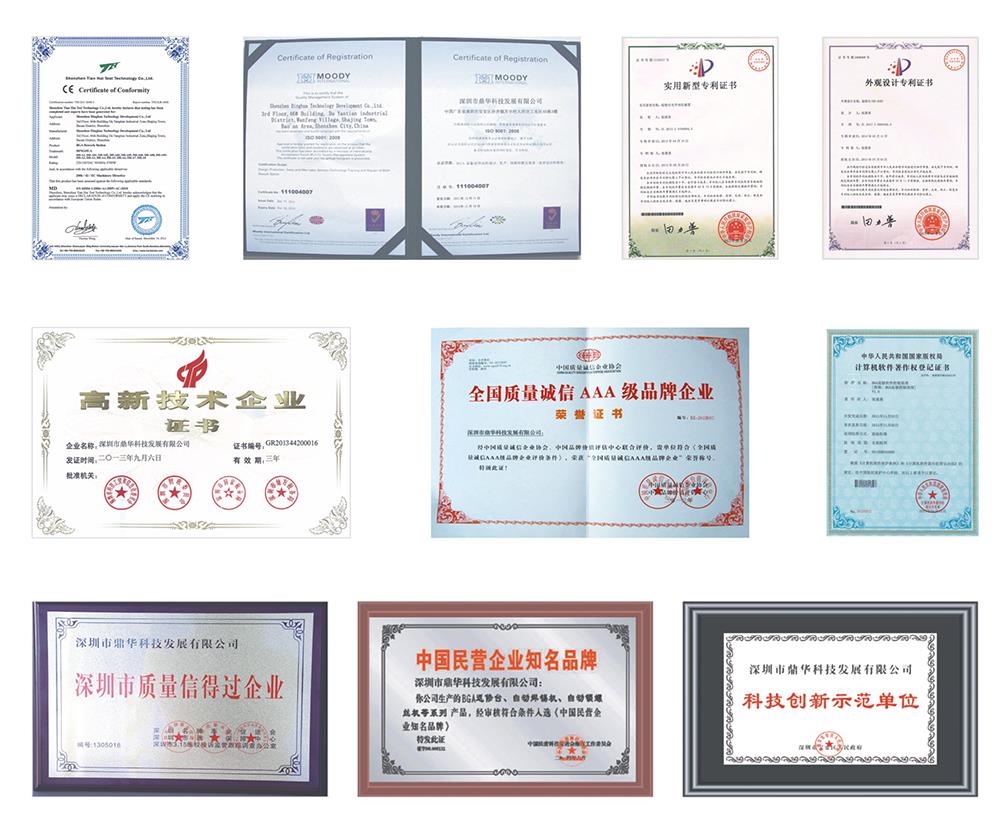

We warmly welcome business partners from all over the world. Feel free to contact us!
7. Related knowledge
Definition and Principles of Soldering
In soldering, "wetting" plays a crucial role. Soldering involves using liquid solder to bond substrates and create a joint. This process is similar to water spreading on a solid surface. However, unlike water, the solder solidifies to form a durable joint as the temperature drops. Ideally, solder bonds with the substrate metal to create a continuous joint. However, in practice, the substrate often has an oxide film formed by exposure to air and the surrounding environment, which inhibits proper wetting. This is similar to pouring water onto a greasy surface, where the water beads up and cannot spread evenly. If the oxide film is not removed, the bonding strength of the solder will be significantly weakened.
1. Difference Between Welding and Gluing
When two materials are bonded with glue, the adhesive provides a mechanical bond between their surfaces. A rough or etched surface offers better adhesion than a shiny surface. Gluing is a surface phenomenon and can be removed when the glue is wet. In contrast, soldering forms a chemical bond between the solder and the metal. The solder molecules penetrate the molecular structure of the substrate's surface metal, creating a strong, fully metallic bond. Once melted, the solder becomes an integral part of the base metal and cannot be wiped off entirely.
2. Wetting vs. Non-Wetting
If a greased metal sheet is immersed in water, the water forms droplets and does not wet the surface. However, if the grease is removed with a cleaning solvent and the sheet is dried, water spreads evenly, forming a thin film. Similarly, for solder to wet a metal surface, both the solder and metal surface must be clean.
3. Cleanliness
For soldering to succeed, the metal surface must be exceptionally clean. When both the solder and metal surface are clean, the solder wets the surface, forming a strong bond. However, most metals oxidize instantly upon exposure to air, creating a thin oxide layer that interferes with wetting. Therefore, removing this oxide layer is critical for achieving strong solder joints.
Note: "Solder" refers to a tin-lead alloy such as 60/40 or 63/37, and the "substrate" is the metal being soldered, such as a PCB or component lead.
4. Capillary Action
When two clean metal surfaces are placed together and immersed in molten solder, the solder wets the surfaces and climbs upward to fill the gap between them through capillary action. If the surfaces are not clean, wetting and capillary action do not occur, leaving the gap unfilled. During wave soldering of plated through-hole PCBs, capillary action fills the hole and forms a "solder joint." However, if the solder's flow is obstructed, the joint may not form completely.


