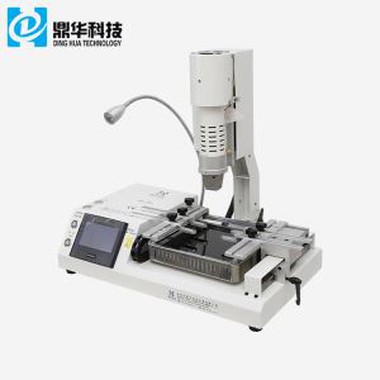
Automatic Reballing BGA Machine
1. DH-A2 automatic machine for reballing BGA with optical alignment 2. High resolution CCD lens camera. 3. 7 inches MCGS Touch Screen (High Definition). 4. Hot air and infrared heating zones.
Description
1.Application Of Automatic Optical Reballing BGA Machine
Work with all kinds of motherboards or PCBA.
Solder, reball, desoldering different kind of chips: BGA,PGA,POP,BQFP,QFN,SOT223,PLCC,TQFP,TDFN,TSOP, PBGA,CPGA,LED chip.


DH-G620 is totally same as DH-A2, automatically desoldering, pick-up, puting back and soldering for a chip, with optical alignment for mounting,no matter whether you have experience or not, you can master it in one hour.

2.Specification of Automatic Optical Reballing BGA Machine
| power | 5300W |
| Top heater | Hot air 1200W |
| Bottom heater | Hot air 1200W.Infrared 2700W |
| Power supply | AC220V±10% 50/60Hz |
| Dimension | L530*W670*H790 mm |
| Positioning | V-groove PCB support, and with external universal fixture |
| Temperature control | K type thermocouple, closed loop control, independent heating |
| Temperature accuracy | ±2℃ |
| PCB size | Max 450*490 mm,Min 22*22 mm |
| Workbench fine-tuning | ±15mm forward/backward,±15mm right/left |
| BGAchip | 80*80-1*1mm |
| Minimum chip spacing | 0.15mm |
| Temp Sensor | 1(optional) |
| Net weight | 70kg |
3.Why Choose Our Automatic Optical Reballing BGA Machine?


4.Certificate
UL, E-MARK, CCC, FCC, CE ROHS certificates. Meanwhile, to improve and perfect the quality system, Dinghua has passed ISO, GMP, FCCA, C-TPAT on-site audit certification.

5.Packing & Shipment

6.Shipment for Automatic Optical Reballing BGA Machine
DHL/TNT/FEDEX. If you want other shipping term, please tell us. We will support you.
Bank transfer, Western Union, Credit Card.
Please tell us if you need other support.
7. Related knowledge
About Flash Chip
Manufacturing Process
The manufacturing process can affect the transistor density and also impact the timing of certain operations. For example, the write stabilization and read settling times mentioned earlier take up a significant portion of the time in our calculations, especially during writing operations. If these times can be reduced, performance can be further improved. Can the 90nm manufacturing process improve performance? Unfortunately, the answer is no! The reality is that as storage density increases, the required read and write settling times also increase. This trend is reflected in the examples provided in previous calculations. Otherwise, the performance improvement in the 4Gb chip would be more noticeable.
Overall, large-capacity NAND-type flash memory chips will have slightly longer addressing and operation times, but as the page capacity increases, the effective transmission rate will still be higher. Large-capacity chips meet the market demand for capacity, cost, and performance. Increasing the number of data lines and increasing the frequency are the most effective ways to improve performance. However, due to process limitations, address information cycles, and certain fixed operation times (such as signal stabilization time), these improvements will not lead to significant year-on-year performance gains.
1 Page = (2K + 64) Bytes;
1 Block = (2K + 64)B × 64 Pages = (128K + 4K) Bytes;
1 Device = (2K + 64)B × 64 Pages × 4096 Blocks = 4224 Mbits
Where:
A0–11 address the page, which can be understood as the "column address."
Addressing pages via A12–29 can be understood as the "row address." For convenience, the "column address" and "row address" are treated as two separate transmission groups rather than combining them into one large group. As a result, there is no data transmission in the last cycle of each group, and the unused data lines remain low. The terms "row address" and "column address" in NAND-type flash memory do not have the same meaning as in DRAM and SRAM, but are simply a convenient expression. To aid understanding, we can visualize a three-dimensional NAND-type flash chip architecture in the vertical direction. In this context, the concepts of "row" and "column" are relatively straightforward.