


SMT BGA Reballing Repair System
A practical and cheap model DH-5830, which is used in VHF/UHF communication equipment, PC motherboards, cell phones, etc. a freely rotated top head and its height adjusted machine, providing different nozzles for components of a motherboard.
Description
SMT BGA reballing repair system
Practical and cheap model DH-5830, used in VHF / UHF communication devices, motherboards for personal computers, mobile phones, etc.
One end on the free pole and the machine adjust the height, providing different nozzles for the motherboard components

The freely rotating top head is very convenient for a chip at a different position on a motherboard to removed or replaced.
Workbench with a size up to 400*420mm meets most all of PCB in nowadays world, such as TV, computer and other appliance etc.
Touchscreen with 7 inches, MCGS brand, HD and sensitive, temperature and time set on it, the real-time temperature can be checked by clicking touchscreen.
The parameter of BGA rework station system
| Power supply | 110~250V 50/60Hz |
| Power | 4800W |
|
Power plug |
USA, EU or CN, option and customize |
| 2 hot air heaters |
For soldering and desoldering |
| IR preheating zone | For a PCB to be preheated before soldering |
| PCB available size | Max 400*390mm |
| A component size | 2*2~75*75mm |
| Net weight | 35kg |
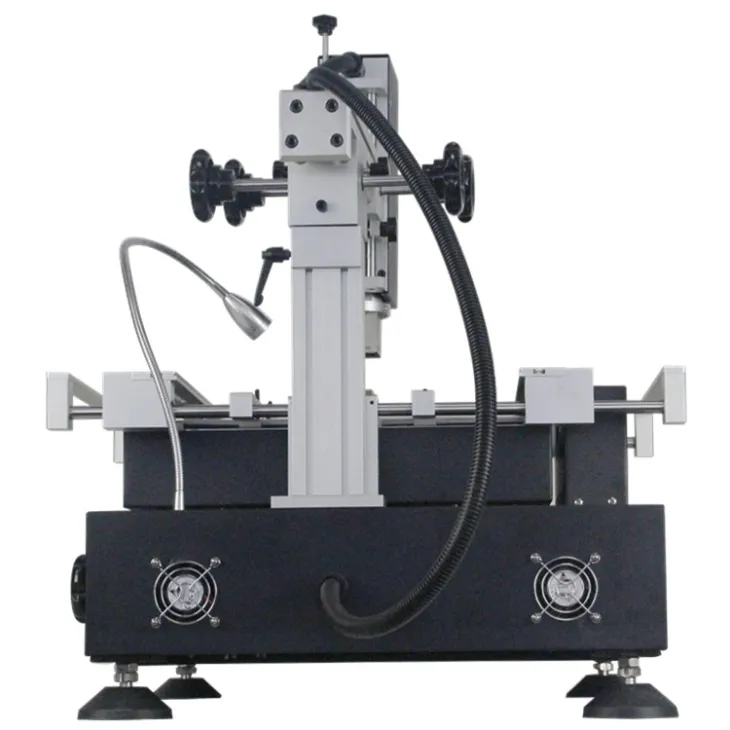
The machine with 4 sides to be viewed as below

Vacuum pen, built-in, 1m long, 3 vacuum caps, which is used for a component picked up or replaced back
from/on a motherboard.

Air switch( for power on/off), in case of being short or leakage, it will be automatic cut off, which makes a technician protected.
Earth wire connector available, we suggest users would better connect it well before using it.

Two cooling fans for the whole machine cooled, which were imported from Delta in Taiwan, powerful
wind and quiet running.
A wire in black and solid spool which supplies power for hot air heater of the top head makes top head can be rotated for a component at a different position on a PCB.
FAQ of BGA Rework System
Q: How to use a BGA reballing kit?
A: When you receive the kit, it comes with a CD that provides instructions. Additionally, we can guide you online.
Q: What are reballing kits?
A: A reballing kit includes items such as solder wick, Kapton tape, soldering balls, BGA flux, and stencils, etc.
Some Skills About Using a BGA Rework Station System
The development of electronic components has become increasingly important as they become smaller and more complex, with more pins (legs). This trend has led to the development of more complex and expensive systems, such as BGA (Ball Grid Array) and CSP (Chip-on-Board) versions, making it difficult to verify the reliability of welds that may be compromised by configuration issues in the cavity. The quality of manual soldering depends on various factors, including the operator's skill, the quality of the materials used, and the effectiveness of the rework station.
Manual soldering is also influenced by the evolving technological landscape, which constantly demands innovative solutions. In manual soldering, the performance of the welding or rework station is closely tied to the operator's skill. A well-designed rework station can achieve excellent results even with a less experienced operator. Conversely, even the most skilled operator cannot overcome the limitations of a poor welding system.
This process has been established to improve rework efficiency, as recovery during rework is often more cost-effective than replacement. High-tech equipment used in rework stations provides excellent control over key variables, ensuring consistent results. This technology allows for efficient heat transfer, which enables repeated soldering at a constant temperature, minimizing vibration caused by slow heat recovery.
The rework process can be broken down into four main stages:
- Removal of components
- Cleaning of pads
- Placement of new components
- Soldering
One of the significant challenges at the production level is applying solder paste to pads when modifying components. If this step is not done correctly, it can negatively affect the integration process in the subsequent stages. If your budget allows, a vision system is highly recommended to improve accuracy.
Additional practical difficulties arise during the rework process, especially as the number of terminals increases and their pitch (spacing) decreases. Typically, the size of the circuit board also shrinks, which reduces the available space and increases the risk of interference with surrounding components.


