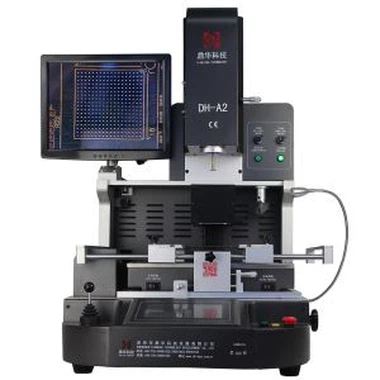
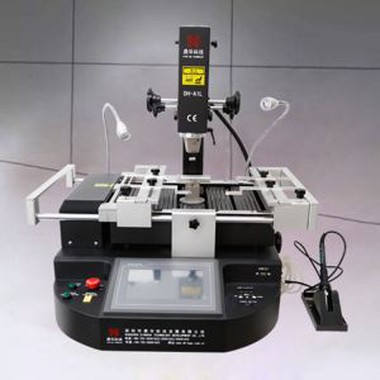
BGA Motherboard Repairing Machine Automatic
Shenzhen Dinghua Technology is the largest manufacturer of BGA Motherboard Repairing Machine Automatic in China. This model is DH-A2, which is popular in Europe market.It functions very well in reballing, remove and replace BGA IC chips. PLS contact us.
Description
BGA Motherboard Repairing Machine Automatic
1. Application Of BGA Motherboard Repairing Machine Automatic
Solder, reball, desoldering different kinds of chips: BGA, PGA, POP, BQFP, QFN, SOT223, PLCC, TQFP, TDFN, TSOP, PBGA, CPGA, LED chip.


2. Product Features

3. Specification

4. Details


5.Why Choose Our Infrared BGA Motherboard Repairing Machine Automatic?


6. Certificate of Optical Alignment BGA Motherboard Repairing Machine Automatic
UL, E-MARK, CCC, FCC, CE ROHS certificates. Meanwhile, to improve and perfect the quality system, Dinghua has passed ISO, GMP, FCCA, and C-TPAT on-site audit certification.

7. Packing & Shipment

8. Shipment for Hot Air BGA Motherboard Repairing Machine Automatic Split Vision
DHL/TNT/FEDEX. If you want another shipping term, please tell us. We will support you.
9. Operation guide for BGA Motherboard Repairing Machine Automatic
11. Related Knowledge of Automatic BGA Motherboard Repairing Machine
- Circuit: A circuit is a conductive loop consisting of metal wires and electrical or electronic components. The simplest circuit connects a power source, load, and components such as wires and switches in a specific way, providing a complete path for charge circulation.
- The path through which current flows is called a circuit. To form a circuit, the following three components are required:
- Power Supply: A device that supplies electrical energy to the circuit and serves as the source of current generation and maintenance. Common power supplies include dry batteries, rechargeable batteries, and various types of generators.
- Load: A device that consumes electrical energy in the circuit. Examples include incandescent bulbs, electric furnaces, and motors, all of which act as loads in a circuit.
Connecting Wires: Wires that connect the power supply and the load, forming a closed loop. Current can only flow in a closed circuit.
In addition to these basic components, actual circuits often include components with specific functions, such as:
- Switches to control the circuit by turning it on or off.
- Measuring instruments to monitor current, voltage, and power consumption.
- Relays and fuses to protect the power supply or circuit from overcurrent damage.
1.2 Current for Automatic BGA Motherboard Repairing Machine
The continuous movement of electric charge in a circuit is called current.
A direct current (DC) has a constant magnitude and direction over time.
An alternating current (AC) changes its magnitude and direction periodically.
The unit of current is amperes (A).
1.3 Voltage for Automatic BGA Motherboard Repairing Machine
The potential difference between two points in a circuit is called voltage.
The unit of voltage is volts (V).
1.4 Power System of Automatic BGA Motherboard Repairing Machine
A power system consists of power generation, substations, transmission, distribution, and user-end electrical equipment. It includes power plants, transmission and distribution lines of different voltage levels, and user-side electrical components.
- Transmission refers to the transportation of large amounts of electricity from power plants or generation centers to consumption areas or between interconnected power grids.
- Power distribution involves delivering electricity to end users within a specific area.
- Transmission facilities include transmission lines, substations, and switch stations.
- Distribution facilities include distribution lines, substations, and transformers.
A transmission grid refers to the power transmission system of the same voltage level, while a distribution network covers power delivery from the transmission grid to end users. These are sometimes referred to as transmission and distribution systems, respectively.
-
China's Transmission Voltage Levels:
- Ultra-high voltage: 1100kV, 750kV, 500kV
- High voltage: 330kV, 220kV, 110kV, 35kV, 10kV, 6kV
- Low voltage: 380V/220V
China's Distribution Voltage Levels:
- High-voltage distribution: 110kV–35kV
- Medium-voltage distribution: 10kV
- Low-voltage distribution: 380V/220V