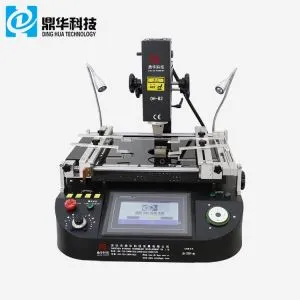
IR Touch Screen SMD Rework Station
• Best in class rework station. • User can directly set up profiles, auto cooling, auto adjust related parameters. • Large 3-zone pre-heating area, ensures consistent heating and eliminates board warpage. • Automated cooling fan reduces cooling times by up to 50%
Description
IR Touch Screen SMD Rework Station
1. Product Features of IR Touch Screen SMD Rework Station

1. High precision temperature thermocouple can feel the actual temperature precisely.
2. DH-B2 BGA Rework Station with alarm function to make you inform the finishing of the desoldering
and soldering process, and it also with a vacuum suction pen to help to remove the chips.
3. DH-B2 BGA Rework Station is designed with a V-groove with a flexible movable fixture to protect the
deformation of the PCB.
4. DH-B2 BGA Rework Station can be used to repair pcb with high temperature demand or lead free
reworking The
5. Hot air nozzles can be rotated 360 degrees, easy to replace.They have a variety of sizes, special requirements
can be customized.
10. DH-B2 BGA Rework Station can repair motherboard for laptop, desktop motherboards, and other large
circuit board repair, and mobile phones and other micro-chip board service.
2.Specification of IR Touch Screen SMD Rework Station

3.Details of IR Touch Screen SMD Rework Station
1.HD Touch screen interface;
2.Three independent heaters ( hot air & infrared );
3. Vacuum pen;
4.Led headlamp.


4.Why Choose Our IR Touch Screen SMD Rework Station?


5.Certificate of IR Touch Screen SMD Rework Station

6.Packing & Shipment of IR Touch Screen SMD Rework Station


8.Related knowledge
Things to note about the SMT process
First of all, lead and lead-free (ROHS) should be divided. The current factory is mainly lead-free process, the following mainly describes the
lead-free process. Precautions for lead-free process line introduction: Manual soldering using lead-free soldering does not absolutely require
a higher soldering temperature. Normal soldering can be performed at a solder tip temperature of 700 to 800 watts. Welding personnel will
notice that the melting temperature efficiency is slower than the traditional Sn63 solder. In addition, it may take slightly longer contact time to
achieve a good welding effect. The appearance of the solder joints will be different in appearance, and the finish will be slightly dull on the
outside, which is lead-free. Typical characteristics of solder. The use of lead-free solders with a higher tin content simply results in corrosion of
the tip, which may necessitate frequent replacement of the tip. 3: Which flux can be used for lead-free solder rework? Lead-free soldering is no
different from Sn63 soldering. Fluxes are no-clean, washable, and rosin types that can be adapted to a variety of welding and reprocessing processes.
Washable fluxes, because of their higher activator concentration, enable more efficient welding. No-clean fluxes are traditionally made from weaker
organic acids, and their welding process is slower if they are exposed to excessively heated environments. It is easier to inactivate. The introduction of
lead-free process has become an overall Zhaoshi that must be seriously faced by all electronic related industries. The lead-free process is not lead-free.
It is also an environmental protection work. It is relative to lead, whether it is process or material. All requirements are high, and some operating skills
need to be overcome and improved in operations.