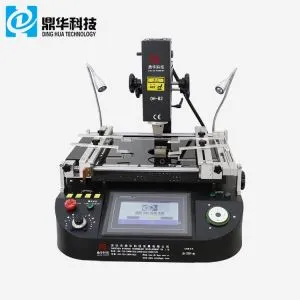
Automatic Sodering Robot
The top quality, stable performance, cost-effective automatic soldering robot Supplied by the 9 years professional Chinese automatic machines designer and Manufacturer Shenzhen Dinghua Innovation Automation Co., Ltd.
Description
Automatic soldering robot DH-HX221
Automatic soldering robot is a revolutionary technological advancement that has significantly transformed
the manufacturing industry. It has brought efficiency, accuracy, and consistency to the process of soldering.
The robot is designed to perform repetitive tasks, which reduces human error and enhances productivity.
One of the key benefits of the automatic soldering robot is that it's programmed to work around the clock,
ensuring that the production process is continuous. This means that industries can produce more goods in a
shorter time, meeting the high demand for their products. Additionally, the machine can work with high
precision, placing the solder exactly where it should be. This reduces wastage and improves the quality of the
output.
Another notable advantage of the automatic soldering robot is that it's equipped with advanced safety features
that protect humans from hazardous soldering environments. The robot is designed to handle hot objects, which
can cause burns to human skin. By using the robot, human workers are shielded from these hazardous situations,
and the process of soldering is safer and healthier.
Furthermore, the automatic soldering robot is programmed to adapt to different products, which allows it to be used
in various industries. This flexibility saves time and money, as there is no need to purchase and set up different machines
for different products. The robot can be programed to handle different soldering demands, and this makes it a versatile
and valuable tool for industries.
In conclusion, the automatic soldering robot is a significant advancement in the manufacturing industry. It has brought
efficiency, accuracy, and safety to the process of soldering. Industries can produce more goods in a shorter time, and
human workers are shielded from hazardous situations. The robot can also adapt to different products, making it a versatile
tool for different industries. The use of the automatic soldering robot is undoubtedly a positive move towards technological
advancement and improved productivity.

I: Description
1.4 axis automatic soldering robot
2.Apply for spot welding, drag welding, curve welding, circle welding,irregular curve continuous welding.
3.Program can be copied.
4.Maximum 999 programs can be stored, different program can be changed simply for different product
with one button, no need to re-program.
5.Customization is optional.
II:Functions
Can input coordinates by clicking “programming”,the program can be copied by point to point or segment to
segment to save time of programming, easy to learn. The spot and the path of soldering can be fully modified.
Can program constant fast spot soldering and guide the welding head to the position of soldering, can change
theinterval time of two products to implement the loop without stopping and improve the efficiency by progra-
mming the teaching pendant simply.
Maximum 999 program profiles can be stored, one machine can solder 999 different products by programming.
The parameters of different spots can be exchanged flexibly, program calibration achieves coordinate position
compensation automatically, with calibration of rotation and correction of wrong operation. The parameter of every
single spot soldering can be configured.
Apply for spot welding, drag welding, curve welding, circle welding and irregular welding, all the welding parameters
can be configured by users for the difficult welding work and micro welding work.
English version interface is easy for the user to debug even without teaching pendant.
Automatic tin feeding, the quantity of tin can be adjusted and controlled precisely. Tin can be feed at anytime to apply
for diversified welding and improve the efficiency.
Weller heating head, the temperature can be controlled precisely to ±2°C, the time and speed of tin feeding can be
adjusted to achieve high quality welding.
Multi-tips is optional for standard array welding.
The stored welding paths can be used at anytime to save the time of programming.
Multiple soldering robots can be operated together by computer control and programming.
With automatic smoke collection and auto clean function.
IV:Technical parameters
Model | DH-HX431 | |
Axis number | 4 axis synchronous | |
Processing scope | X axis | 200mm |
Y axis | 300mm | |
Z axis | 200mm | |
R axis | ±360° | |
Max bearing capacity | 5kg | |
Max speed | XY axis | 800mm/sec. |
Z axis | 450mm/sec. | |
R axis | 360°/sec. | |
Repeated precision | X,Y axis | ±0.02mm |
Z axis | ±0.02mm | |
R axis | ±0.02° | |
Max product size | 150*200mm(X,Y) | |
Stored Programs | 999 profiles | |
Drive system | Close-loop | |
Control system | Movement control system | |
Temperature range | 40-450℃ | |
Temperature precision | ±2℃ | |
Heating head alarm range | 2-99℃ | |
Feeding | Single tin feeding system | |
Heating power | 200w | |
Tin feeding speed | 0-50mm/s | |
Tin diameter | Φ0.5-Φ1.2(standard) | |
Alarms | Tin broken, Tin blocked, heater alarm | |
Dimension | L320*W290*H810mm | |
Input | AC220V±10% 50/60Hz 450VA | |
Air pressure | 0.4-0.8Mpa | |
Humidity | 20-95% | |
Work temperature | -10-45℃ | |
Net weight | 45kg |
V:Key materials
No. | Material Name | Brand | Remarks |
1 | Machine body | Dinghua | |
2 | Horizontal guid rail | Customized from Taiwan | |
3 | Close-loop motor and driver | Leadshine | |
4 | Belt+close-loop | Mikipulley | |
5 | Power | Mingwell | |
6 | Photoelectric sensor | Omron | |
7 | Relay | Omron | |
8 | Switch | Fuji | |
9 | U Sensor | Omron | |
10 | Heater | Weller |
Our Company

Certificate


5.FAQ of automatic soldering robot
Q: What is an automatic soldering robot?
A: An automatic soldering robot is a machine that can perform soldering tasks without the need for human
intervention. It is equipped with advanced features such as a robotic arm, a soldering iron, and a soldering
station to perform high-quality soldering tasks with precision and accuracy.
Q: What are the benefits of using an automatic soldering robot?
A: Using an automatic soldering robot can offer many benefits, such as increased productivity, consistent quality,
reduced labor costs, improved safety, and greater efficiency. It can perform complex soldering tasks that require
high precision and accuracy, enabling businesses to deliver high-quality products to their customers.
Q: How does an automatic soldering robot work?
A: An automatic soldering robot works by using a pre-programmed set of instructions to perform soldering tasks.
The robotic arm of the machine is programmed to hold the soldering iron and move it to the designated location
on the PCB (print circuit board) to perform soldering. The machine is also equipped with sensors and cameras to
ensure accurate placement of the soldering iron and precise application of heat to the solder.
Q: What types of applications can an automatic soldering robot be used for?
A: An automatic soldering robot can be used for a wide range of applications, including electronics manufacturing,
automotive, medical devices, aerospace, and consumer products. The machine can perform soldering tasks on a
variety of materials such as metals, plastics, and ceramics, making it highly versatile and useful in a variety of industries.
Q: Is it easy to operate an automatic soldering robot?
A: Yes, operating an automatic soldering robot is relatively easy. The machine is equipped with a user-friendly interface,
making it simple even for non-technical personnel to use. Moreover, the machine is pre-programmed with soldering
instructions, reducing the need for additional training for employees.
In conclusion, an automatic soldering robot is an advanced machine that can offer many benefits to businesses. It can
perform high-quality soldering tasks with precision and accuracy, increasing productivity, and reducing labor costs. With
its versatility and user-friendly interface, it is an excellent investment for companies looking to improve their manufac-turing
processes.